
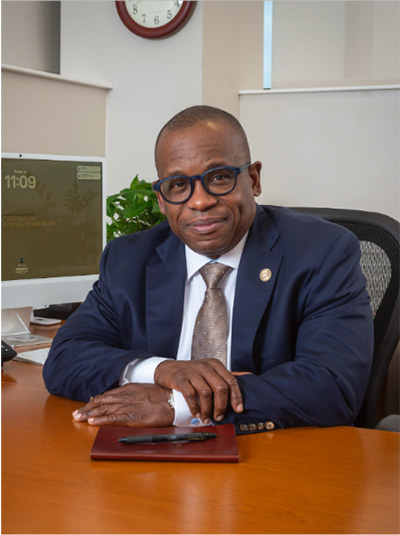
The Hal B. Jenson, MD Dean, President and CEO
Since taking the helm nearly seven months ago as the Hal B. Jenson, MD Dean, President and CEO at Western Michigan University Homer Stryker M.D. School of Medicine (WMed), J. Adrian Tyndall, MD, MPH, FACEP, has had a front-row seat to witness the incredible impact our learners at the medical school and students at Western Michigan University (WMU) have on the Kalamazoo community and the patients they serve in Southwest Michigan.
This month, he sat down to reflect on what he’s seen, what he’s learned, and the important work that lies ahead.
Each summer in Kalamazoo brings with it a time of excitement as we welcome new students and residents, and WMU welcomes new students to its health professions programs. Talk about the positive impact this new cohort of learners has in the community and what tangible examples of that impact you’ve seen since arriving at WMed in March.
Dr. Tyndall: I've had seven months to really think about this, to meet people, talk to people, to experience what's going on in the community … and it's just been terrific. There's energy that arrives with a new class, and you could literally feel it building.
Every summer, WMed welcomes a new group of students, more than 75 residents and fellows come through the doors, and Western welcomes its own cohorts in the health professions. Nursing and occupational therapy, physician assistant studies, speech and language pathology are just a few of their many programs.
Several hundred people are now coming into the community to spend some of the most demanding years of their professional lives and, frankly speaking, many will stay.
I think the impact shows up in a couple of ways. Since March, I've watched our students present at WMed Research Day on topics ranging from health-related social needs in the emergency department to pediatric iron deficiency in low-resource settings. I've seen our residents staffing the clinics where many of our neighbors receive their primary care. I've seen learners volunteer at community events, coach youth programs, show up at the YMCA breakfast and the YWCA Women of Achievement celebration.
On Match Day in March, seven members of our graduating class chose to stay at WMed for residency, and 25 chose to stay in Michigan. Those are physicians who are already part of this community.
The less visible impact, though, is the economic and civic impact. Learners rent apartments, they eat at restaurants, they bring families and partners. Some put down roots here. They bring new ideas into institutions.
They remind us all of why this work matters, and it's hard to become cynical when you're working alongside someone at the beginning of their career who sees medicine as a calling. And when you are part of a learning environment like this, it is one of those things that just inspires you.
And so, I've enjoyed this time; I've enjoyed seeing these transitions.
Research shows that doctors are better doctors when there is a learner in the room. Talk more about this and your experiences precepting residents and students.
Dr. Tyndall: I believe this deeply. I'm an emergency physician. I spent 27 years of my life and my clinical career in academic emergency departments where almost always there was a student or a resident at my side.
The presence of a learner really changes how you practice. You must explain your reasoning out loud, which means you have to have a reason and reasoning. You must justify why you're ordering the test, you must talk about why you're choosing one medication over another, or why you're sending a patient home instead of admitting them.
Learners ask questions that experienced physicians have often stopped asking. And they notice things that we have learned to look past. They read something maybe last week that we read 15 years ago.
I believe teaching hospitals consistently perform well in quality and safety measures, in part because of the discipline that comes from being observed and questioned every day. And I think that a patient who's seen by a resident and an attending has really been seen twice, and that redundancy catches errors.
So, my own reflections on precepting and my memories about that are probably some of the best experiences of my career. I think there's nothing like watching a nervous third-year student make a diagnosis of their own for the first time or watching a senior resident run a resuscitation while you stand back in the room and realize you're no longer needed — that moment when you’ve become completely unnecessary in the space because this trainee is ready to be on their own.
That's the whole point of this, and that is why I believe that academic medicine and institutions that embrace academic medicine are really a special place.
And for me, it's about building our replacements. The only way to do that is by uplifting these institutions that value academic medicine and value the whole experience of teaching and learning.
I think it's extraordinarily important.
As the new learners arrive, they become part of an educational mission in the community that WMed, WMU and our teaching hospitals help mold. Why is that collaboration between the medical school, Western, Beacon and Bronson important, in your opinion, and how does it help foster a strong academic environment and clinical settings that foster improved patient outcomes?
Dr. Tyndall: I think we're unique in a couple of ways.
First, WMed exists because of that collaboration. This institution was founded in 2011 as a partnership between Western Michigan University and Kalamazoo's two health systems, and the structure is relatively distinctive. We are an independent, community-based medical school with unique relationships; most medical schools do not have a structure quite like ours.
We're a partnership, and that means that everything we do depends on the strength of the relationships among the four institutions.
The University brings research infrastructure and the broader academic community. The hospitals bring the patients, the clinical faculty, and some of the places where the learning happens. The medical school brings the curriculum, accreditation, the residency programs and the faculty who really tie this all together.
And none of the four can produce a physician alone. But together we do. And the physicians we produce are trained across two health systems alongside nurses, therapists, physician assistants and others from the University, which is exactly how they'll practice.
The connection to patient outcomes is direct. Academic medical centers bring the latest evidence to the bedside faster. They attract specialists who want to teach and do research. They participate in clinical trials that give local patients access to treatments they otherwise would have to travel long distances to receive.
One of our clinical partners was recognized as one of the top academic medical centers in the United States for 2026 by Premier’s 100 Top Hospitals program. While this is a reflection of their commitment, it could not have occurred without this kind of relationship and collaboration among our institutions.
Our DNA is based upon this kind of collaboration, and to increase the momentum, we must tighten that collaboration. We must ensure that we have more connections, more synapses, and strengthen those relationships.
The 1,300 employed and community faculty at WMed work alongside our students and residents once they arrive in Kalamazoo. How important are those faculty members as they commit to educating and training our students and residents, as well as aspiring nurses and other healthcare professionals?
Dr. Tyndall: The employed and community faculty are the institution, and I'm saying that without any kind of exaggeration.
At most medical schools, the teaching is done primarily by full-time employed faculty. At WMed, the majority of the physicians who teach our students and residents are community physicians who practice at Beacon or Bronson or in private practices across Southwest Michigan, and most of them do it as volunteers. It’s fantastic to see this work
They open their clinics, they open their operating rooms to learners, they stay late to review a case, and they write letters of recommendation. They do this on top of a full clinical load, and I think they do this because they believe in it.
I've said this to our community faculty directly, and I'll keep saying it: The word "academic" in academic medical center is not just a decorative title. It is what they bring to life every single day.
When I attended our residency graduations in June, what struck me the most was how many of the people in those rooms were community physicians who had spent years shaping the graduates walking across the stage.
And I think that model — a community that teaches its own physicians — is one of the most distinctive features about WMed. It's something I intend to carry to the national stage when I work with the AAMC, because we all are fretting about what the future of academic medicine could be or should be.
And I want us to demonstrate that, with the right conditions, this is a sustainable model. And that it can work.
Those 1,300 or so employed and community faculty at WMed — they are the institution. They help to define the sustainability of our missions.
More than 260 residents and fellows from WMed care for patients in Kalamazoo and Southwest Michigan. Talk about the value these physicians bring to our local hospitals, emergency rooms, surgical suites and primary care offices during their years of training in Kalamazoo.
Dr. Tyndall: Our residents and fellows are on the floors of the hospitals at 3 a.m., they're in the emergency department when a trauma comes in, they're delivering babies, working in intensive care units, and seeing patients in our psychiatric clinics. They're providing care in Battle Creek through our family medicine program there.
Many of the patients in Southwest Michigan who see a physician on any given day are probably also seeing a WMed resident.
Residents extend the capacity of every hospital and clinic where they work. They allow attending physicians to care for more patients and to care for those patients more thoroughly. They staff clinics that serve patients who might otherwise have nowhere to go. And because they're early in their careers, they bring current training. They bring fresh questions and stamina.
So, a community of this size with this many residents and fellows is a community with far more clinical capacity than it would otherwise have, and that's just some the value that is brought here by WMed.
And I think that this is part of what was recognized by those who created our institution, and it's a really critical legacy.
From 2021 to 2025, more than 70 WMed resident physicians who trained here were hired by Beacon, Bronson, WMed or at another employer within 50 miles of Kalamazoo. How does this help strengthen our local physician workforce, and why is that important for the community and the patients we serve?
Dr. Tyndall: Where a physician trains is a strong predictor of where they're going to practice, and that's not just our finding. This is a national finding, and it's why I think residency programs matter so much to the region's workforce.
Seventy physicians in five years chose to stay within a 50-mile radius of Kalamazoo, and I think that's a remarkable number for a community of this size.
Those are physicians who know our hospitals, they know our referral patterns, they know our patient population. They've built relationships already with the colleagues they'll work alongside for decades.
And for patients, it also means continuity. It means the physician who trained in the emergency department is now an attending there, and the resident who rotated through a family medicine clinic is now seeing patients in that clinic, potentially as a partner.
It means a workforce that reflects the community it serves, and for the region, I think it's one of the most efficient economic development strategies that we have available.
Every physician who stays represents a practice, a set of jobs or a family that puts down roots. We are, in a real sense, growing our own when we do that, and so we want to see more of it.
We want pathway programs that will expand the aperture for students in our area to see a route through our local community colleges and universities to our medical school. And we're looking at opportunities to help accelerate their transition to training and residency.
When that happens, we'll see more of these stories that strengthen the community.
From my perspective, this is where WMed really plays an extraordinarily important role in strengthening our community. So, it's not just about healthcare, it's about healthcare-plus, and that's important.
Statistics show that the U.S. is facing a significant physician shortage at a time when the population is continuing to grow and the number of Americans over the age of 65 increased by 41 percent as of last year. How is WMed positioning itself now — and in the future — to help address this shortage?
Dr. Tyndall: The shortage is real, and it will be felt most acutely in communities like ours outside major metropolitan areas.
I believe WMed is positioning itself in three critical ways.
I think the first is scale and retention. We graduate a class of medical students every year, and we train more than 260 residents and fellows. A large share of them will end up staying and providing clinical expertise here, particularly in primary care and psychiatry and the specialties that are most needed in Southwest Michigan.
The second is the pathway. The physician shortage can't be solved at the medical school level alone; by the time someone applies to medical school, most of the decisions that determine whether they will get in have already been made.
So, that's why I end up caring so much more about reaching young people early in the K-12 schools of this region. We want to show them that medicine and science are careers they can pursue to make a difference right here at home.
A region that can grow its own physicians from its own communities has a durable answer to the shortage.
And the third is partnership. Physicians don't practice alone. The nurses, physician assistants, therapists and other professionals that Western trains are part of the same workforce, and the health systems that employ them are the same ones that employ our graduates.
I believe that the more tightly WMed, Western, Bronson and Beacon plan together, the better positioned this region will be to meet the moment.
With a medical school, a research university, two strong clinical partners and a highly philanthropic community that has always invested in health, I believe my job is to make all those pieces work collaboratively, and I think that becomes the durable strategy for WMed.
It's about partnership.
That became very clear to me at the beginning when I first got here, and it's become even clearer over the last several months. These durable partnerships absolutely matter for the sustainable success of our missions and the impact to our community and our region.