
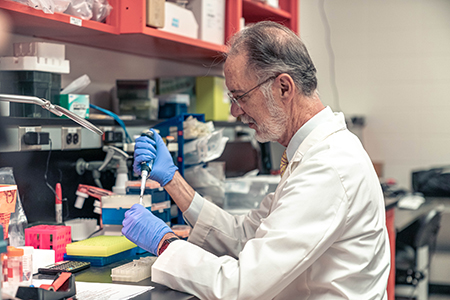
Throughout his career, Thomas L. Rothstein, MD, PhD, has often wondered whether science could exist in an environment of sharing and collegiality.
Ten years ago, when he was approached with the opportunity to build a new research program focused on immunobiology at WMU Homer Stryker M.D. School of Medicine (WMed) from the ground up, Dr. Rothstein decided to see for himself, recruiting Nichol Holodick, PhD, from his prior lab at the Feinstein Institute for Medical Research to help him develop a research environment rooted in collaboration.
“The pitch from WMed sort of made it clear that I might have an opportunity to put into practice what I had imagined,” said Dr. Rothstein, who serves as chair of the Department of Investigative Medicine and leads the Center for Immunobiology at WMed. “I’ve always dreamed of having a division where people cooperate, where everyone is invested in everyone else's success as well as their own. And we've achieved that here. We have a wonderful group of top-notch scientists who all believe that we will all be successful together.”
Since its inception in 2016, the Center for Immunobiology has grown to include five principal investigators – Momoko Yoshimoto, MD, PhD; Christopher Jondle, PhD; Hiroyuki Hirakawa, MD, PhD, and Drs. Rothstein and Holodick. Together, they bring complementary expertise and distinct research programs to the center, while collaborating on projects that draw on the strengths of multiple laboratories.
“What started as a very small group has grown into a nationally recognized research program,” said Dr. Holodick, associate professor in the Department of Investigative Medicine. “Everyone brings different scientific strengths, and I think one of the things we’re most proud of is the collaborative environment we’ve built and how willing people are to help each other succeed. To see our department grow from essentially nothing over the past decade has been incredibly rewarding.”
Research faculty and staff at WMed routinely connect and engage through a variety of forums, including Research in Progress, where faculty take turns discussing their ongoing research, fielding questions and considering new perspectives; Journal Club, where a faculty member selects a current significant paper in the field for the group to evaluate in detail; grant and manuscript writing workshops, where faculty members offer advice and constructive feedback on grant applications and manuscripts; and Seminars in Investigative Medicine, a monthly series that attracts nationally known speakers who have made significant advances in their field.
“Nichol and Tom had a great vision for what the research program could be here at WMed,” said Michael Clemente, MS, SCYM (ASCP), senior manager of WMed’s Flow Cytometry and Imaging Core. “When I arrived in 2017, I was immediately impressed with the aspects of collegiality and collaboration. It's been great to work with different people and help them get their projects going, and it's been amazing to see the grant success that we've had.”
The collaborative environment has spawned numerous National Institutes of Health (NIH) grants, including a multi-PI five-year, $3.8 million R01 grant for a project led by Drs. Holodick, Rothstein, and Yoshimoto titled “The Role of Biological Sex in the Self-renewal of B1 Cells into Old Age in Mice and Humans.” Altogether, the center, now part of the Department of Investigative Medicine, has obtained more than $17.5 million in extramural grant support, with additional grant applications currently pending.
“This is the dream to be honest,” Dr. Rothstein said, “That we can get a bunch of investigators together, pursuing the same overall goal in different ways, working with each other, and, ultimately, obtaining NIH awards to support our group activity.”
A special symposium celebrating Dr. Rothstein's 45 years of scientific mentorship and discovery, his 80th birthday, and the first decade of growth and discovery within the Center for Immunobiology and Department of Investigative Medicine at WMed will be held Oct. 22-23 at the W.E. Upjohn Campus in downtown Kalamazoo.
The symposium, Building the Future Together: Discovery, Mentorship, and Scientific Leadership Across Generations, will bring together some of Dr. Rothstein’s former trainees, colleagues, and members of the WMed community for scientific talks and conversations about careers, mentorship, and the future of biomedical research.
“Our goal is really to build community through this event,” Dr. Holodick said. “We feel it’s extremely important to acknowledge what's been built here and the career that Tom has had, while also highlighting and showcasing the variety of career pathways within science that can make an impact.”
Reflecting on a decade of research within the Center for Immunobiology, Dr. Rothstein said the “secret sauce” of success has been the people.
“We have a great group of people that are incredibly smart, that interact and work together, that publish papers and write grants together, and the payoff is the scientific advances made here at WMed and the national reputations that several of our members have already achieved,” Dr. Rothstein said. “Everybody has a hand in it. Everybody is interested in the science and pushing it forward.”