
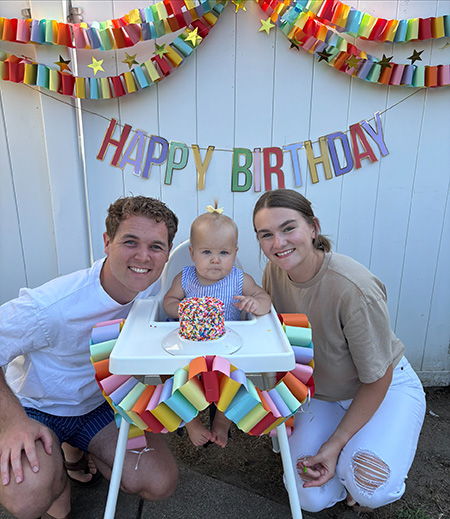
When he talks now about that day this past August, Jeremy Wilson remembers it was the sound of his infant daughter’s cough that first got his attention.
As he turned his eyes to Elsie, then 11 months old, he saw her gasp for air and then go quiet with a panicked look on her small face. Her lips were turning blue as he rushed over to help.
It was a moment that, rightfully, could have sent any parent reeling in panic but Wilson, a first-year student at WMU Homer Stryker M.D. School of Medicine (WMed), said the medical first responder (MFR) training he and his classmates completed shortly after arriving in Kalamazoo in June gave him the tools to react without hesitation – quickly and calmly – and save his daughter’s life.
“I took her out of her highchair, put her on my knee and began back blows,” Wilson said of the steps he took to try to dislodge the small piece of ground beef that was blocking his daughter’s airway. “I flipped her over and she was still gasping so I did five more back blows. Then she let out a cry which was a huge relief because it was then that I knew she was OK.”
As everything unfolded that day, Wilson said the incident felt like it lasted a couple of minutes or more. But his mother, who was in town visiting in August and sitting with Elsie when she began to choke, told her son later that his quick actions took all of 30 seconds or less.
“She was impressed by how quickly and decisively I handled it,” Wilson said of his mother. “She was sitting next to Elsie and saw what was happening. Before she thought to do anything, I was already there getting her out of the chair.”
Thankfully, Wilson said his daughter, who celebrated her first birthday in August, is doing well and was even ready to eat again within minutes after the incident.
Wilson said a basic life support course he completed prior to medical school taught him what steps he needed to take in the type of emergency that occurred that day. But his MFR training at WMed, he said, ingrained in him “the ability to act and think quickly under pressure.”
“Before MFR I would not have been able to react the same way as I did in that situation,” he said.
WMed students spend some of their very first weeks of medical school participating in MFR training. The two-week course equips students to respond when someone is ill or injured and provides them with instruction on basic procedures, including taking vital signs, CPR, airway management, oxygen administration, bleeding control, wound care and splinting, administering life-saving medications like naloxone and epinephrine, and assisting in childbirth.
The course culminates with the MFR capstone event, and the training qualifies students for national certification and state licensing as medical first responders. WMed is the only medical school in Michigan and one of only five in the nation to provide this type of training.
Wilson said the two weeks of training for him and his classmates included taking part in more than 30 emergency scenarios per day. He said the repetition of learning what actions to take during the high-pressure exercises gives him and his classmates the ability to act decisively in real-world emergencies. He said it also provides what Bill Fales, MD, professor in the Department of Emergency Medicine, who leads the MFR training course and serves as chief of the Division of EMS and Disaster Medicine, calls “stress inoculation.”
“I was able to think clearly and act decisively in a very stressful moment, and it was almost like muscle memory because of that exposure to stress over and over,” said Wilson, a native of Phoenix who earned a degree in microbiology from Utah Valley University before coming to WMed.