
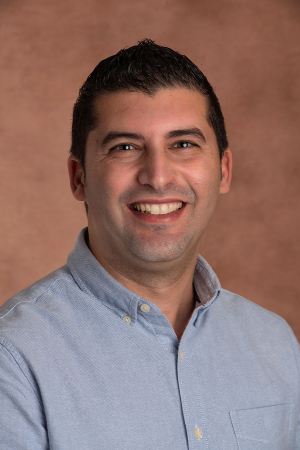
Throughout his career, Adil Akkouch, PhD, has focused his research on developing biomaterials that mimic the chemical composition of bone to support bone regeneration.
Now, bolstered by a three-year, $570,000 R15 grant awarded to WMU Homer Stryker M.D. School of Medicine (WMed) in August by the National Institute of Arthritis and Musculoskeletal and Skin Diseases (NIAMS), part of the National Institutes of Health (NIH), Dr. Akkouch is building upon his prior research by investigating innovative surface-modification strategies for polyetheretherketone (PEEK) biomaterials to enhance their performance in orthopedic applications.
“The ultimate goal is to advance orthopedic implants to the next level,” said Dr. Akkouch, associate professor in the Department of Surgical Sciences. “Creating more interactive, smarter implants that can support bone regeneration.”
Orthopedic implant failure remains a pressing clinical challenge, particularly among aging and diabetic populations, where impaired healing, chronic inflammation, and systemic dysregulation limit treatment efficacy. PEEK, a thermoplastic polymer used as a medical implant material, offers favorable mechanical properties, radiolucency, and biocompatibility, Dr. Akkouch said, but its lack of bioactivity and tendency to provoke pro-inflammatory immune responses currently limit its long-term clinical success.
“The proposed research introduces a novel, dual-function surface modification strategy that integrates precisely controlled microscale porosity with a bioactive mineralized collagen coating embedded with microRNA-26a,” Dr. Akkouch said. “This innovative approach is designed to replicate the microarchitecture of native bone resorption pits, support osteoblast attachment and differentiation, and modulate macrophage polarization toward the regenerative M2 phenotype.”
The project, which will include medical students, is structured around three specific aims:
- Engineering modified PEEK implants using NaCl leaching to generate osteoclast-inspired microscale porosity, followed by low-temperature adsorption of Coll/HA–miR-26a to create a bioactive and immunomodulatory surface.
- Evaluating osteoblast response to the modified surfaces, focusing on miR-26a uptake, proliferation, osteogenic differentiation, and activation of Wnt/β-catenin signaling.
- Assessing macrophage adhesion, phenotype polarization, and cytokine expression, with an emphasis on suppressing M1-driven inflammation and promoting M2-mediated tissue regeneration.
“To receive this grant is amazing,” Dr. Akkouch said. “It demonstrates recognition from my peers in the field that this research has meaning, and we can advance the field with it. My ultimate goal is to advance orthopedic implant technology and enhance the quality of life for patients undergoing bone repair surgeries.”
The project also provides a meaningful opportunity for Dr. Akkouch to pursue one of his greatest passions — training and inspiring the next generation of medical students and future scientists through hands-on research.
“Education and research go hand in hand.” Dr. Akkouch said. “When you are able to teach a student new technologies or new skills in the lab, for me, this is the best feeling.”