
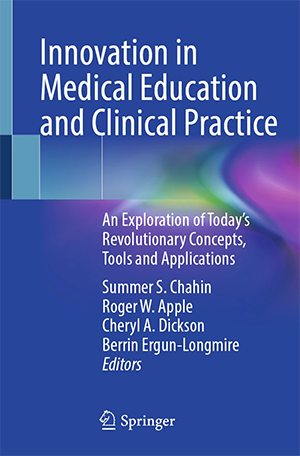
A new book authored by WMed medical students, residents, and faculty, and Western Michigan University psychology students, showcases the power of collaboration, scholarship, and shared experiences in medicine.
Blending diverse perspectives from learners and educators alike, Innovation in Medical Education and Clinical Practice: An Exploration of Today’s Revolutionary Concepts, Tools and Applications highlights thoughtful insights, personal reflections, and meaningful contributions to the evolving field of healthcare.
The book, crafted over the course of two years and published this spring, features 44 student authors from across the medical school. Summer Chahin, PhD, Roger Apple, PhD, Cheryl Dickson, MD, and Berrin Ergun-Longmire MD, faculty members in the Department of Pediatric and Adolescent Medicine, served as the book’s editors.
“We had this idea of innovation and why not have the new and upcoming physicians and psychologists talk about innovations in these disciplines,” Dr. Apple said. “One of the standout features of the book is that the students are lead authors. They did a lot of hard work; I can’t stress that enough. We didn’t put very many constraints on them. People are really the most creative when you don't have all kinds of guidelines, and I think this book really helps illustrate that.”
Dr. Chahin served as lead editor for the book, developing the entire table of contents and recruiting Drs. Apple, Dickson, and Longmire as additional editors. From there, writers were recruited; each chapter was student-led but also included a faculty author.
“I was very lucky because I had the opportunity to read every single word in this book multiple times, and it was really cool to see different versions of it from beginning to end and what people were putting together,” Dr. Chahin said. “I thoroughly enjoyed being able to serve as a mentor for these students, and I would do it again.”
The book highlights new and innovative practices in primary care and medical subspecialties, with a special focus on new and innovative ideas in incorporating health equity and cultural humility. It also provides a comprehensive work of new and innovative ideas that can be used as a guide for medical practice.
“Medicine is constantly evolving,” Dr. Dickson said. “This was an opportunity to demonstrate forward thinking, outlining what newer things are happening in medical education while at the same time evaluating, where are we as an institution? What are the kinds of things we need to think about doing if we’re not already doing them? I’m incredibly proud of our students for their ability to do this. It’s been a great success.”
For M3 Shireen Husami, co-authoring a chapter on health equity and innovation was particularly meaningful.
“Health equity has always been very important to me. Making sure people are getting what they need and helping vulnerable populations, it’s why I wanted to go into medicine,” Husami said. “We organized our chapter in micro, meso, and macro levels, explaining how to implement health equity promoting strategies in smaller level interactions, in community level interactions, and in larger scale policy and advocacy work. Having the autonomy to be able to organize this chapter in that way and work with other people was very, very cool.”
M2 Allen Terteryan joined the project during his first year of medical school, co-authoring a chapter on technology as a tool for improving patient safety.
“This project required the functioning of a very well-oiled machine. Everyone did their part. Everyone played a role,” Terteryan said. “I learned a lot being involved in this book, not just in terms of how to do research and how to organize everything and how to go about it systematically, but I learned a lot about medicine.”
Pediatric Psychology Intern Lowell Bouchard co-authored a chapter on the introduction of telehealth in psychological services. While he had prior research experience, serving as the lead author of a book chapter was an entirely new challenge.
“It was interesting to look at how telehealth has been adapted, outlining the limitations from a medical perspective as well as from a psychological perspective. It was challenging, but it was very much worth the effort,” Bouchard said. “This was such a great group of people to be able to work with, and to have editors that gave you free reign to be able to talk about your topic in the way that you felt would best capture it. The freedom to do that, I really enjoyed it.”