
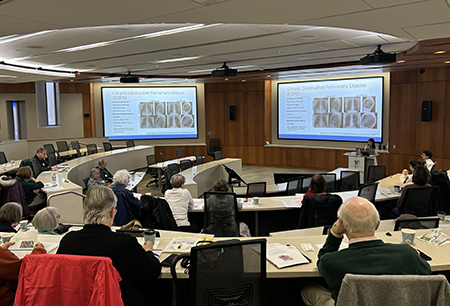
A new program at WMU Homer Stryker M.D. School of Medicine (WMed) is offering an engaging introduction to the world of medicine for community members interested in health and wellness.
Mini Medical School, launched in partnership with the Osher Lifelong Learning Institute (OLLI) at Western Michigan University, explores the scientific foundations of health and disease in an accessible, interactive format, covering topics such as cardiovascular health, immunology, pulmonary function, physiology, and pharmacology.
The four-week course, held at the W.E. Upjohn M.D. Campus, welcomed its first cohort of nearly 30 community members in late January, and is led by first- and second-year medical students, with support from Liz Lorbeer, EdM, chair and professor in the medical school’s Department of Medical Library, and Shadi Adineh, coordinator for Community Education and Engagement.
OLLI, a volunteer-driven organization that offers a variety of programs designed for older adults aged 50 and older throughout Southwest Michigan, has been a tremendous partner, according to Lorbeer.
“Mini Medical School fosters meaningful intergenerational learning, enriching the experience for all participants,” Lorbeer said. “Students refine their patient-centered communication and plain language skills, while older community members enhance their health literacy and confidence in engaging with healthcare providers. The program creates a reciprocal learning environment that benefits both groups.”
Each weekly two-hour session featured lively lectures and interactive discussions aimed at sparking curiosity and encouraging questions, with medical students presenting the various topics in clear, everyday plain language.
Participants who attended all four sessions received a Mini Medical School certificate of attendance courtesy of Robert G. Sawyer, MD, the Hal B. Jenson, MD Dean of the medical school. Attendees also had the opportunity to participate in an optional walking tour of the WMed Simulation Center.
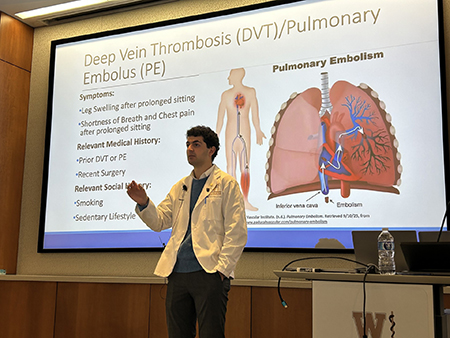
M2 Charles Gu and M1 Mary Engle were among 14 medical student presenters involved in Mini Medical School, developing a presentation on the heart and lungs with fellow medical students, M2 Katie Joo and M1 Maurice Safar.
“I joined this project because I feel like people outside of medical school often do not understand what we are learning,” Gu said. “The biggest thing we hope attendees take away from this program is guidance on how to maintain a healthy lifestyle, and just recognizing signs and symptoms, things like shortness of breath and chest pain. A lot of people tend to ignore these symptoms and try to push through them, but those are very serious signs that require medical attention.”
Mini Medical School has also provided a great opportunity for students to sharpen their communication skills.
“I really enjoy teaching,” Engle said. “Learning how to best explain things is important. One explanation might not be good enough for everyone, so allowing the audience to ask further questions and responding provides great experience explaining these medical concepts in multiple ways.”
Lorbeer intends to offer Mini Medical School three times a year at the W.E. Upjohn M.D. Campus, with the next sessions planned for this summer.
Response to the program has been incredibly positive, Lorbeer said. A particularly memorable moment happened after the first session, when a woman in the audience shared that her late husband’s body was donated to WMed through the Body Donation Program, where it was used to teach students and physicians about the structure of the human body.
"I wanted to come to this because it helps me experience medical school,” the woman told Lorbeer. “It helps me to fully understand what you're doing, and I wanted to be in the same building as my husband.”
“That was a really beautiful moment,” Lorbeer said. “Overall, the feedback we’ve gotten on this program has been tremendous. It brings me a lot of joy.”