
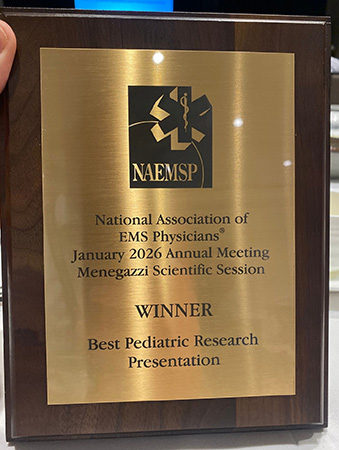
An interdisciplinary team leading a first-of-its-kind research study at WMU Homer Stryker M.D. School of Medicine (WMed) aimed at improving prehospital care for children was recognized for its efforts in January with the Best Pediatric Research Presentation Award at the National Association of EMS Physicians (NAEMSP) Annual Meeting.
The award is the culmination of a three-year study – “Augmenting the On-Scene Medic (ATOM): Development of a head-mounted display application to reduce prehospital pediatric medication errors” – led by John Hoyle, MD, professor and chair of the Department of Emergency Medicine and associate dean for Simulation at WMed.
"The ATOM team is amazing to work with as were all of our EMS agencies and partners, and we've accomplished something that no other individual or group has been able to – a substantial reduction in prehospital pediatric medication administration errors,” Dr. Hoyle said. “This work will have a significant impact on improving safety for children and saving lives. This application represents a tool that our EMS colleagues have been requesting for years to help them with a very, very difficult job.”
In addition to Dr. Hoyle, members of the ATOM research team include Tycho Fredericks, PhD, professor in the Department of Industrial and Entrepreneurial Engineering at Western Michigan University (WMU); Bryan Harmer, PhD, a critical care paramedic, assistant professor of Nursing at Creighton University, and adjunct clinical assistant professor in the Department of Emergency Medicine at WMed; Lee Wells, PhD, assistant professor in the Department of Industrial and Entrepreneurial Engineering and Engineering Management at WMU; Autumn Edwards, PhD, professor in the School of Communication at WMU who also serves as co-director of WMU’s Communication and Social Robotics Labs; Sue Dunwoody, MS: KC Christopher, MS; Adam Lacznar, MS; Kalsie Vanlinder, EMT-P; Megan Van Loo, EMT-P; Noah Olweean, EMT-P; Bill Rantz, PhD, professor in the College of Aviation and Department of Psychology at WMU; Prashant Mahajan, MD, vice chair for the Department of Emergency Medicine and professor of Emergency Medicine and Pediatrics at the University of Michigan; Vitaliy Popov, PhD, assistant professor of Health Sciences at U-M Medical School, assistant professor in the U-M School of Information, and director of Learning Services and Technology for the Clinical Simulation Center at U-M; Guan Yue Hong, PhD, Department of Computer Science at WMU; Stephanie Van Alsten, MD, assistant professor in the Department of Emergency Medicine, and Alex Lindsey, BS.
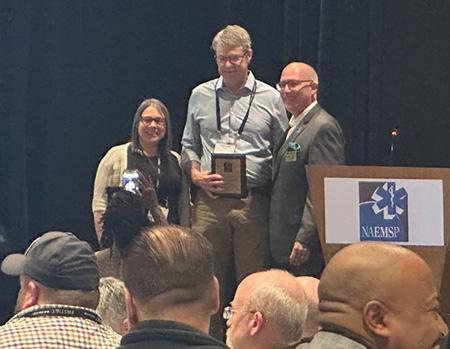
Members of the team, including Drs. Hoyle and Harmer, as well as Christopher, Lacznar, and Wells, presented a total of six abstracts, two oral presentations and four poster presentations at the NAEMSP conference in January.
The ATOM study was launched in 2023 and buoyed by a three-year, $1.37 million grant from the U.S. Department of Health and Human Services Agency for Healthcare Research and Quality. Since then, the research team has done extensive work in the field with the goal of developing an application for the Microsoft HoloLens, a popular wearable augmented-reality technology to help paramedics more accurately deliver medications to young patients.
The study’s objective – to reduce medication-dosing errors that occur when children are treated by emergency medical services – comes as errors associated with pediatric medication administration in EMS are alarmingly high. While EMS calls involving critically ill children are relatively rare, making up just 1-3 percent of all emergency encounters for paramedics, the incidents are often intense and studies have shown that there is a 31 percent error rate across all drugs administered to children by EMS. Medications such as midazolam and fentanyl have even higher rates at 61 percent and 35 percent, respectively.
The application developed by the team reduced dosing errors from 52 percent to 6 percent in a large randomized controlled trial involving seven EMS agencies in Michigan and Indiana.
The idea for the research project using the Microsoft HoloLens began in 2021 when Dr. Harmer approached Dr. Hoyle after reading his previous research on pediatric dosage errors in the prehospital setting and proposed the development of an augmented-reality device application to combat the ongoing issue. Those conversations led to discussions with Dr. Mahajan at U-M and the constructing of the research team.
Since that time, the team’s research has included a thorough examination of the characteristics of pediatric medication administration and the use of a comprehensive design thinking process to develop a prototype application for the HoloLens, examine usability of the prototype, and test the safety and efficacy in a randomized controlled trial. The team had set a potential goal of the application for the HoloLens to be ready for distribution some time in 2029.
"Our next steps are to seek out funding so we can build out the remaining clinical indications for the application and then get it out to paramedics for use in the field and training,” Dr. Hoyle said. “This is not only a great clinical tool but our EMS partners have said they would really like to have the ATOM software for their pediatric training as well.”