
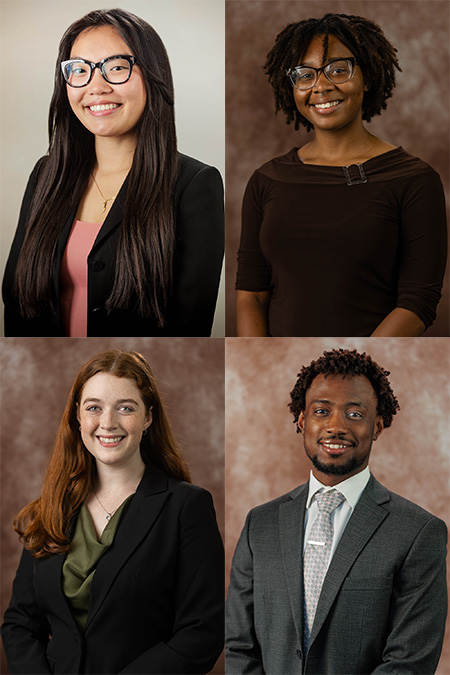
In November, as a day full of activities for Michigan Medical Education Day (MMED) was coming to a close at the W.E. Upjohn M.D. Campus, four student ambassadors from WMU Homer Stryker M.D. School of Medicine (WMed), were near the end of a tour and preparing to highlight the medical school’s Simulation Center for a group of attendees that included undergraduate students and their advisors.
“It was fun,” M1 Maia Newkirk said of the tour and MMED, which took place on November 8. “The Sim Center was the very last stop on the tour and we were saving the best for last.”
But for Newkirk and the other student ambassadors with her – M2 JaVaughn King, M3 Skylar Ketteler, and M4 Mussa Ibrahim – the day took an unexpected turn when the aspiring physicians were suddenly confronted with an emergency situation during the tour.
“We were walking down the hallway in the Simulation Center when one of the students suddenly collapsed,” Newkirk recalled. “We recognized quickly that something was wrong.”
In that moment, Newkirk, King, Ketteler, and Ibrahim said they turned to the skills they each learned from Medical First Responder (MFR) training as first-year students at WMed to help the student who had collapsed.
“We all just kind of jumped in,” Ibrahim said. “It’s really helpful to have that kind of training that’s been drilled into you to fall back on in those moments.”
While King called 911, Newkirk, Ibrahim, and Ketteler assessed the student and determined the student was having a seizure. They rolled the student on their side, checked their airway and circulation, and monitored their breathing. They reassured the student they were in a safe place and that the students were calling for more help.
On the phone with a dispatcher, King provided information about the time intervals between the student’s seizures. She also gathered medical information from the student’s advisor, including the student’s medical history, and relayed it to the dispatcher.
“We all tried to help the best way we could, and I knew communication would be really important, and getting help from people who were more equipped to handle the situation than us was also critical,” King said.
As the situation unfolded, Ketteler said she gathered the rest of the attendees on the tour to take them to the Simulation Center and clear the area so King, Newkirk, and Ibrahim could continue providing care to the student in need.
Once EMTs from Life EMS arrived at the W.E. Upjohn M.D. Campus, the students were able to quickly provide information to them, and the student was taken to a local hospital for further treatment.
Newkirk, a Grand Rapids native who worked as an EMT while she pursued her degree in chemical engineering at Michigan Technological University, said she was appreciative that the MFR training she and her classmates received during their M1 years allowed the group to quickly work as a team to help the student.
“MFR was an amazing refresher for me,” Newkirk said. “We were able to quickly come together as a team that day, and being able to do that was really incredible. Each of us had that same training and knew we could handle the situation with a lot of capability.”
WMed students receive training and are certified as medical first responders during their first year of medical school. The two-week course qualifies students for national certification and state licensing as medical first responders.
MFR training is a unique part of the medical school’s curriculum, which provides early exposure to the clinical setting, and the course equips students to respond when someone is ill or injured and provides instruction on basic procedures, including taking vital signs, performing CPR, bandaging, wound care and splinting, and assisting in childbirth, among other things.
The training continues for students after their first year with an advanced cardiac life support course along with trainings in the field and in the WMed Simulation Center.
“All of us, with our MFR training, we were able to assume roles immediately that day and everything was very natural and fluid,” said Ketteler, a native of Lincoln, Nebraska, and alumna of the University of Michigan where she earned her bachelor’s degree in cellular and molecular biology. “As a M3 and coming from core rotations, I haven’t been in an emergent situation outside of the hospital before. I wondered how I would react and I’m really grateful for our MFR training and the attention to detail we had to focus on.
“Everything was almost gut instinct,” Ketteler added. “We were so confident in what we were doing that it allowed us to stay calm and support the student, and the training was invaluable for that.”
King said MFR training gave her the skills to be able to quickly recognize and respond to an emergency.
“Learning what to do in those situations where your quick actions matter was really important to me, and it’s something that is unique to WMed,” said King, a Chicago native and alumna of Ohio State University where she earned a bachelor’s degree in neuroscience. “I was glad I had those skills and that we were able to help the student that day. Afterwards, we talked as a group and I was appreciative that we came together and checked in on each other.”
Ibrahim, an Ann Arbor native who earned his bachelor’s degree in neuroscience from Earlham College, said he was impressed with the skills his classmates displayed in November and he was grateful for how quickly everyone stepped up to help.
“Having those basic skills from our MFR training can really be the difference between life and death,” Ibrahim said. “And gaining those skills early on in the first year of medical school makes you feel like you’re really getting started in a way that’s hands-on and different from just spending time in the classroom.”