

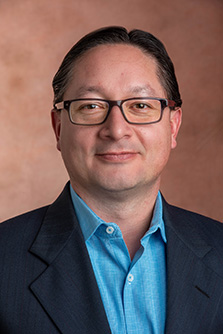
Interim Department Chair
Welcome from the Department Chair
We are a supportive department of educators and scholars in medical education, biomedical and clinical sciences, community research, and health systems. Our goal is to develop scientifically literate physicians equipped to deliver excellent team-based health care for all. United by a commitment to innovation, evidence-based practice, and equity, we engage in teaching, research, and service that supports the mission of WMed in collaboration with our communities.
The faculty in the Department of Biomedical Sciences are committed to successful mastery and integration of the foundational basic sciences that are vital for the success of our medical students. A foundation is formed by the traditional biomedical science disciplines, including anatomy, biochemistry, cellular and molecular biology, immunology, microbiology, neuroscience, pharmacology, and physiology. Our faculty oversee the incorporation of these basic sciences within the context of relevant clinical applications throughout the four-year undergraduate medical education program in the medical school.
For each course in the Foundations of Medicine curriculum (Years 1 and 2), a faculty member from the department serves as the basic science course director and shares responsibility with a corresponding clinical course director. With their clinical counterparts, departmental faculty design, develop, and implement an integrated basic and clinical science curriculum for each undergraduate course.
We strive to help our medical students understand the foundational science in a meaningful manner that supports both life-long learning in the biomedical sciences and effective clinical practice. We aim to help students at WMed apply their foundational science knowledge to the appropriate clinical problems they will encounter as students and physicians. This goal is achieved using diverse pedagogical approaches that are grounded in adult learning theory, with a curriculum that:
- guides students in acquiring important information and reasoning skills.
- helps students make the curriculum content relevant and meaningful.
- assists students in transferring classroom learning into real-life applications.
The Department of Biomedical Sciences provides a home and supporting environment to foster faculty research programs and create meaningful opportunities for students to engage in scholarly work at the medical school. Over the past four years, more than 80 percent of our faculty have mentored medical students in laboratory, medical education, clinical research and other scholarly activities. Through these mentorships, students from all four years of medical school have participated. Together, our faculty and students pursue translational and applied research addressing important problems and challenges in human health, medical education, and health care delivery.